Displayr Design System
System Design
From zero to a 27 component design system in a month, establishing the rules Displayr needed to make consistent UI decisions going forward.
Displayr is an advanced, AI-focused data insights and dashboard platform used by leading market research agencies worldwide. A UI redesign in 2023 did not establish a design system leading to inconsistencies across the software. In ealrly 2026, I was brought in to build one from scratch. That meant auditing what already existed, identifying the visual values buried within years of inconsistent decisions, and turning them into a set of rules the whole company could use.
Working as a solo designer on a three-month internship, scope management was critical. Establish a token structure, while foundational to any mature design system, wasn’t going to be possible within the timeline. The v0 focused on the core components: dropdowns, buttons, tabs, tree tabs, file trees, notifications, and tooltips. Each component went through a review with my manager to catch any edge cases I might have missed, and once signed off, we started directing people toward the system. Engineers building a new feature would be able to pull directly from the design system, completely avoiding the need to reach out to me for 90% of use cases
The system shipped with 27 components. The seven key components had fully completed documentation, with the remainder carrying definition, purpose, guidelines, anatomy, and values. The impact showed up quickly in the places it mattered. Spacing went from an incoherent spread of values (1px, 3px, 5px, 13px, 15px) to a clean scale of 0, 2, 4, 8, 12, and 16px. Icon sizing followed the same logic, moving from an illogical 16, 20, 25, and 32px to a proper 16, 20, 24, and 32px. Engineers started using it to guide UI decisions, and if a component was going to be used in a one-off way that didn't fit the system, the answer became: change the approach, not the system.
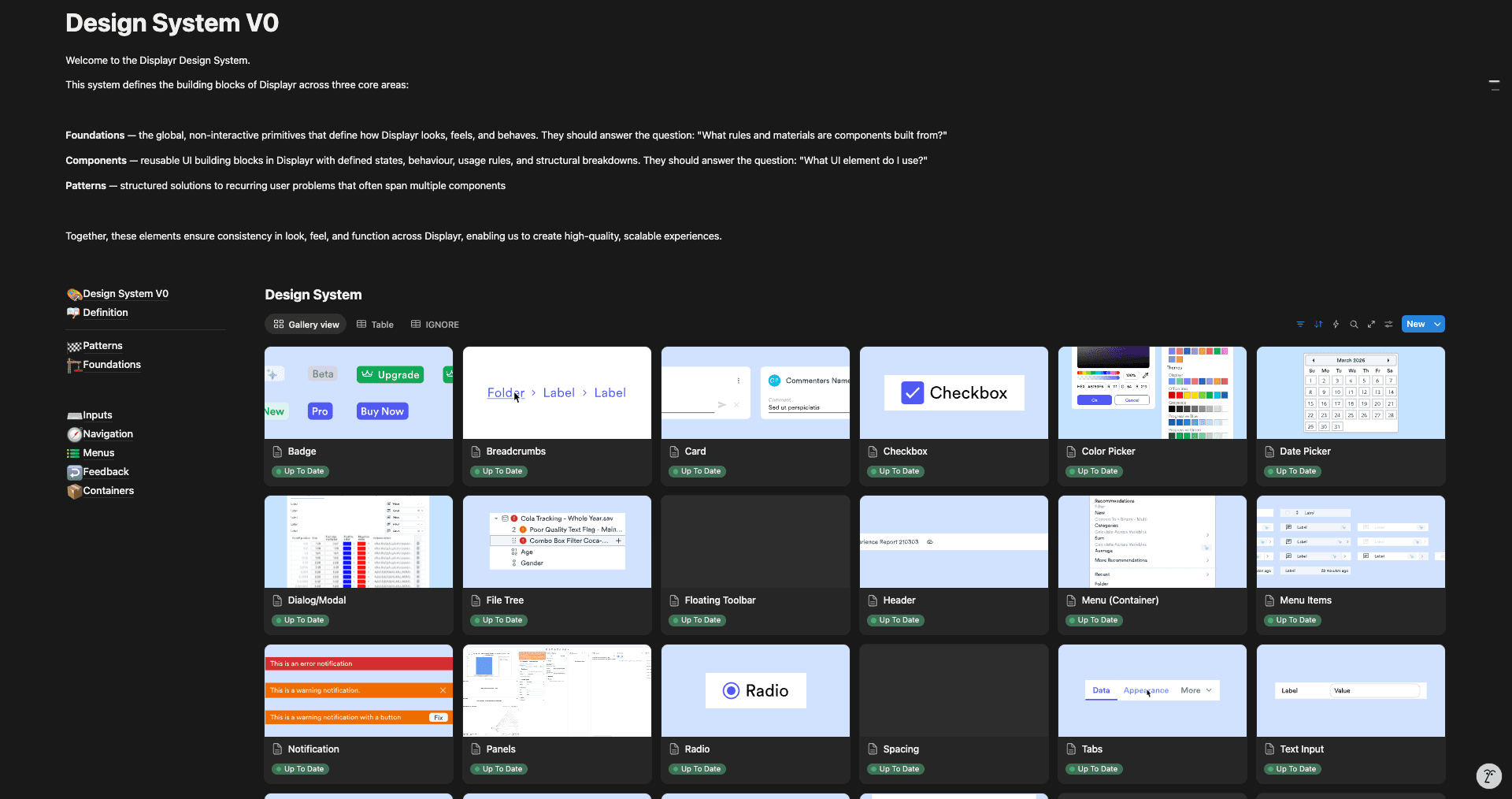
Looking back, I over-scoped it. I wanted to ship something comprehensive and that was too ambitious for the timeline. The most important thing this project taught me was knowing when and where to cut and understanding what's absolutely necessary versus what can be pushed to a later version. As a junior designer in a company that's 95% engineers, learning to advocate for what genuinely matters from a design perspective was its own skill entirely.